Drought-tolerant plants, soil preparation, mulch, and efficient irrigation can increase initial scope, while traditional turf may cost less to establish but creates recurring watering and lawn-care requirements.
Home / insights / xeriscaping-vs-traditional-lawn-cost
xeriscaping-vs-traditional-lawn-cost
Stone set to outlast
the house it surrounds.
Terraces, walls, and pavements engineered to a 50-year
standard — drawn, specified, and built by a single studio.
Ecological Landscaping Benefits
Xeriscaping vs Traditional Lawn Turf: Cost and Maintenance Comparison for Rocklin and Roseville
Compare xeriscaping and traditional turf through the decisions that shape long-term landscape ownership: installation, ongoing maintenance, irrigation demand, seasonal care, drought-tolerant planting, water efficiency, environmental considerations, and local conservation planning.
Cost Structure
Xeriscaping may cost more initially but changes the long-term maintenance equation.
A xeriscape can include drought-tolerant plants, soil preparation, mulch, and efficient irrigation. Traditional turf may be less expensive to establish initially but typically requires recurring watering, mowing, fertilization, and related lawn care.
Water + Maintenance
The two landscapes require very different ongoing routines.
Xeriscape care emphasizes plant health, mulch, pruning, weed control, soil moisture, and targeted irrigation. Turfgrass generally requires more frequent mowing, consistent irrigation, fertilization, and seasonal lawn management.
Local Decision
Choose around the property, lifestyle, water strategy, and desired landscape character.
Rocklin and Roseville homeowners should compare upfront cost, water use, seasonal upkeep, ecological goals, and current conservation programs before deciding how much lawn to retain. If the garden also includes water features and ecosystem ponds, budget separately for their water demand and maintenance; these are not inherently water-saving xeriscape features.
Home / insights /xeriscaping-vs-traditional-lawn-cost
xeriscaping-vs-traditional-lawn-cost
Ecological Landscaping Benefits
Xeriscaping vs Traditional Lawn Turf: Cost and Maintenance Comparison for Rocklin and Roseville
Compare xeriscaping and traditional turf through installation, maintenance, irrigation demand, seasonal care, drought-tolerant planting, water efficiency, ecological considerations, and local conservation planning.
Quick Summary
Swipe cards
Xeriscape care centers on plant health, pruning, mulch, weeds, soil moisture, and targeted irrigation. Turfgrass generally requires mowing, irrigation, fertilization, edging, and seasonal lawn management.
Rocklin and Roseville homeowners should weigh cost, water use, upkeep, ecological goals, and current conservation programs when deciding how much turf to keep. For water features and ecosystem ponds, plan water use and maintenance separately; neither is inherently a water-saving xeriscape feature.
Interactive Landscape Comparison
Compare what each landscape asks of your property.
Move through installation, ongoing costs, irrigation demand, maintenance, seasonal care, ecological considerations, and local conservation planning to understand how xeriscaping differs from traditional turfgrass.
01 / Landscape Strategy
The comparison begins with two very different approaches to water and care.
Xeriscaping uses drought-tolerant planting and water-efficient design to reduce reliance on regular irrigation. Traditional turfgrass creates a continuous green lawn but generally requires more frequent watering, mowing, fertilization, and seasonal upkeep.
Xeriscaping emphasizes drought-resistant plants and targeted irrigation.
Traditional turf emphasizes uniform lawn coverage and regular cultural care.
The better fit depends on lifestyle, appearance, budget, water strategy, and maintenance expectations.
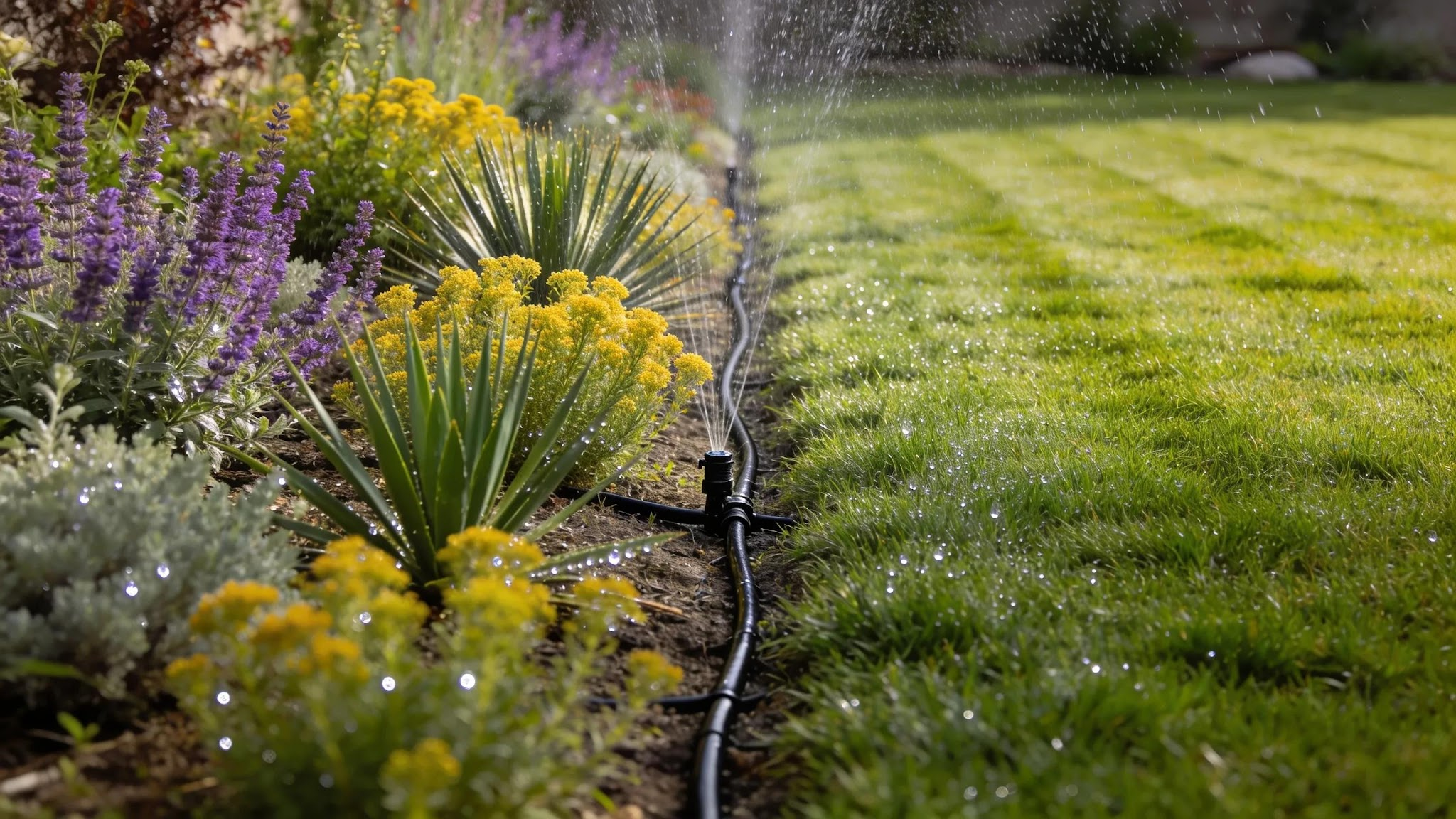 Two landscape strategies create two very different ownership routines.
02 / Installation + Cost
Upfront investment and ongoing expense should be evaluated together.
The source presents xeriscaping as typically requiring a higher initial investment because planting, soil preparation, mulch, and efficient irrigation may be part of the installation. Traditional turf can cost less initially, but recurring watering and lawn-care requirements affect long-term ownership.
Xeriscape installation can include drought-tolerant plants and drip irrigation.
Turfgrass generally has a lower initial establishment cost in the supplied article.
Compare long-term maintenance and water requirements rather than installation price alone.
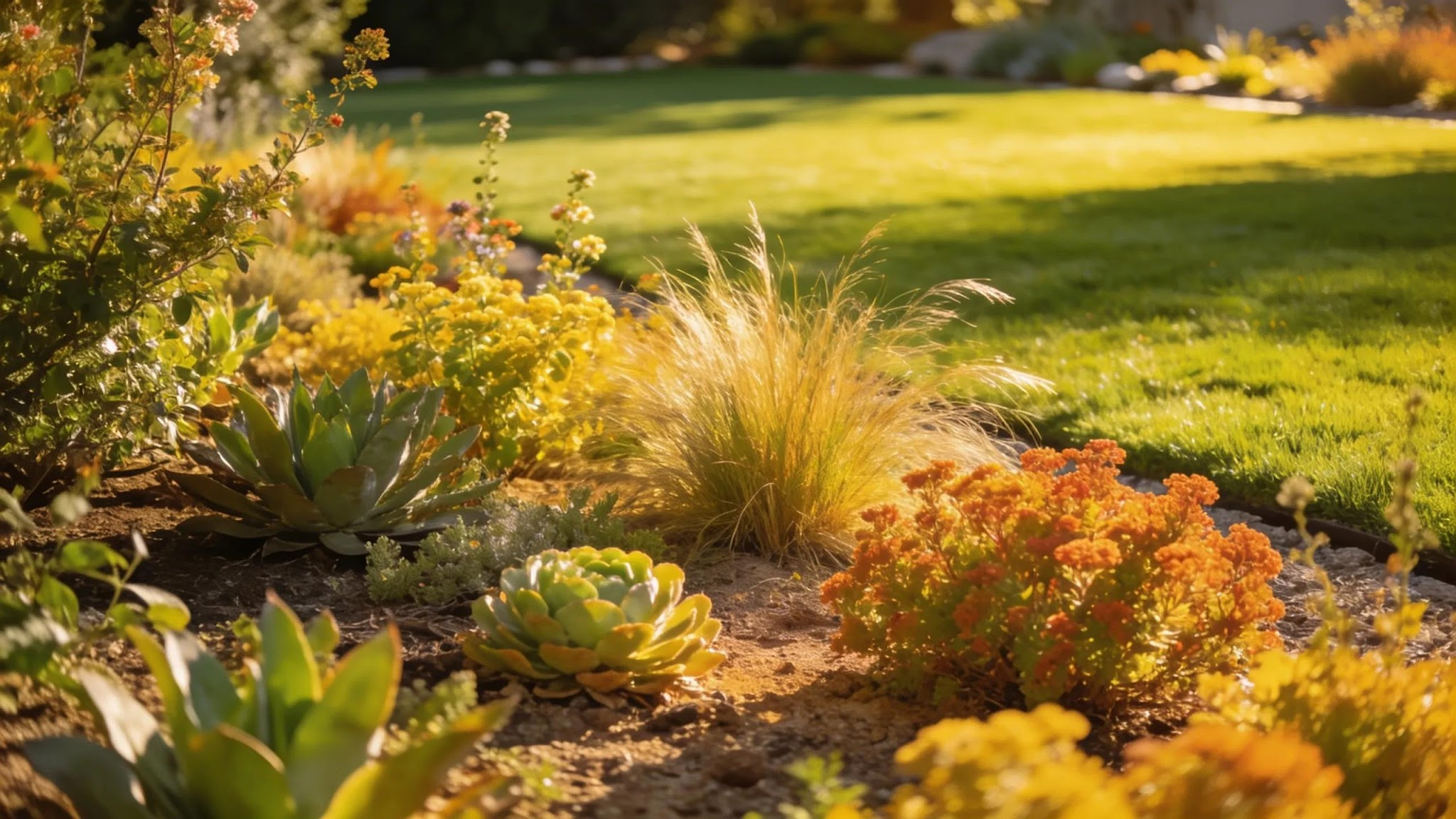 Installation cost is only the beginning of the ownership comparison.
03 / Water + Irrigation
Water demand is one of the largest differences between xeriscape and turf.
Xeriscaping uses plants adapted to lower-water conditions and can pair them with targeted irrigation such as drip systems. Traditional lawns generally depend on more consistent irrigation to maintain a uniform green surface.
Drought-tolerant and locally adapted plants can require less supplemental irrigation once established.
Drip irrigation targets water closer to plant root zones.
Turfgrass usually requires regular irrigation across the full lawn area.
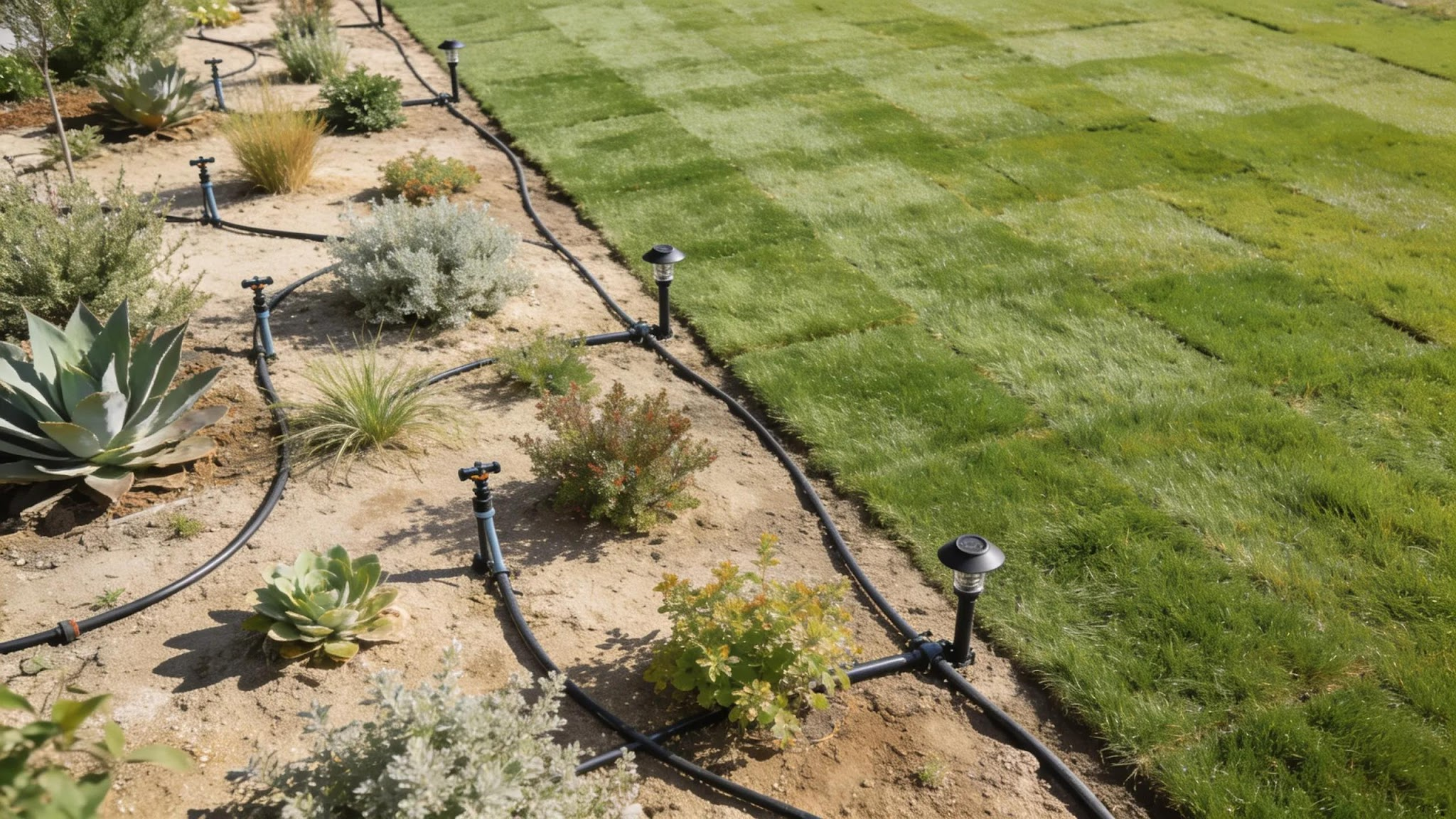 Water-efficient design changes both irrigation demand and maintenance behavior.
04 / Maintenance + Seasons
Xeriscape is not maintenance-free — it simply requires a different rhythm.
Xeriscape maintenance focuses on mulch, weed management, soil moisture, pruning, plant health, occasional replacement, and seasonal irrigation adjustments. Turf maintenance typically includes mowing, fertilization, watering, pest management, and maintaining an even lawn appearance.
Xeriscape: pruning, mulch, weeds, plant replacement, and moisture monitoring.
Turfgrass: frequent mowing, fertilization, irrigation, and lawn care.
Seasonal workload and desired appearance should influence the choice.
Lower-water landscaping still needs intentional horticultural care.
05 / Ecology + Landscape
A planted xeriscape is different from replacing vegetation with bare rock.
The source connects water-efficient landscaping with native and drought-tolerant plants, habitat value, biodiversity, reduced reliance on fertilizers and pesticides, and lower chemical runoff. A successful xeriscape remains a designed living landscape rather than simply removing lawn.
Native and climate-adapted plants can support local habitat.
Reduced lawn area can reduce some fertilizer, pesticide, and mowing requirements.
Keep living plant material central to the design instead of treating xeriscaping as a rock-only landscape.
Water-wise landscaping can still be layered, planted, ecological, and visually rich.
06 / Local Planning
Conservation programs can change, so verify what applies today.
The supplied article discusses California turf-reduction incentives, water-conservation rebates, and drought-related policies. These programs can vary by location, water provider, funding cycle, eligibility, and project type, so Rocklin and Roseville homeowners should confirm current requirements before including an incentive in the project budget.
Confirm the current water provider and program serving the property.
Review eligibility before removing existing lawn or beginning construction.
Do not assume a rebate mentioned in editorial content is still available.
Verify current programs before building an incentive into the budget.
01
/ 06
Compare
Interactive Landscape Comparison
Compare what each landscape asks of your property.
Explore installation, ongoing costs, irrigation demand, seasonal care, drought-tolerant planting, ecological considerations, and local conservation planning.
Two landscape strategies create two very different ownership routines.
01 / Landscape Strategy
The comparison begins with two different approaches to water and care.
Xeriscaping uses drought-tolerant planting and water-efficient design to reduce reliance on regular irrigation. Traditional turf creates a continuous lawn but generally requires more frequent watering and recurring lawn care.
Xeriscape emphasizes drought-resistant plants and targeted irrigation.
Turfgrass emphasizes continuous lawn coverage and regular care.
Lifestyle, water strategy, appearance, budget, and maintenance should guide the choice.
Installation cost is only the beginning of the ownership comparison.
02 / Installation + Cost
Upfront investment and recurring expense should be evaluated together.
The source presents xeriscaping as typically requiring greater initial investment because planting, soil preparation, mulch, and efficient irrigation may be part of the installation. Turf can cost less initially while introducing recurring care expenses.
Xeriscaping can include plants, soil work, mulch, and drip irrigation.
Turf establishment may carry a lower initial cost in the source.
Long-term water and maintenance requirements belong in the comparison.
Water-efficient design changes both irrigation demand and maintenance behavior.
03 / Water + Irrigation
Irrigation demand is one of the largest differences between xeriscape and turf.
Xeriscaping can use plants adapted to lower-water conditions and targeted irrigation such as drip systems. Traditional lawns generally require more consistent irrigation across the entire turf area.
Drought-tolerant plants can require less supplemental irrigation once established.
Drip systems target water closer to plant root zones.
Turfgrass typically requires regular irrigation across the full lawn.
Lower-water landscaping still needs intentional horticultural care.
04 / Maintenance + Seasons
Xeriscape is not maintenance-free — it requires a different rhythm.
Xeriscape care focuses on mulch, weeds, pruning, soil moisture, plant health, selective replacement, and seasonal irrigation adjustments. Turf care typically includes mowing, watering, fertilization, edging, and other lawn-health practices.
Xeriscape: pruning, mulch, weeds, irrigation checks, and plant care.
Turf: mowing, watering, fertilization, edging, and lawn management.
Maintenance preference should be part of the design decision.
Water-wise landscaping can still be layered, planted, ecological, and visually rich.
05 / Ecology + Landscape
A planted xeriscape is different from replacing vegetation with bare rock.
The source connects xeriscaping with drought-tolerant and native planting, habitat value, biodiversity, reduced reliance on some fertilizers and pesticides, and lower chemical runoff.
Native and climate-adapted plants can support local habitat.
Reduced lawn area can reduce some mowing and chemical-input requirements.
Keep living plant material central rather than turning xeriscape into a rock-only landscape.
Verify current programs before building an incentive into the project budget.
06 / Local Planning
Conservation programs can change, so verify what applies today.
The source discusses California turf-reduction incentives and water-conservation programs. Actual availability can vary by provider, funding cycle, location, eligibility, and project requirements.
Identify the water provider serving the property.
Confirm current eligibility before removing lawn or beginning construction.
Do not assume an editorial rebate reference is currently available.
01
/ 06
Compare
Detailed Landscape Comparison
Compare both landscapes across six ownership decisions.
Explore the deeper trade-offs between xeriscaping and turfgrass through installation cost, annual upkeep, water demand, seasonal routines, ecological design, and current local planning considerations.
Landscape Ownership Map
The right landscape is not defined by lawn versus no lawn alone — it depends on how cost, water, horticulture, maintenance, ecology, and lifestyle fit the property.
Comparing:
Cost Foundation
01 / Cost Foundation
Installation and annual upkeep tell different parts of the cost story.
Installation Structure
Xeriscaping often shifts more investment into the initial landscape conversion.
Xeriscape installation may include drought-tolerant plants, planting preparation, soil improvements, mulch, and efficient irrigation such as drip systems. Traditional turfgrass can require less initial landscape complexity but introduces a different ongoing care profile.
Plant selection and planting density affect xeriscape cost.
Soil preparation and irrigation design affect either landscape.
Compare complete installed scope rather than plant or sod pricing alone.
Initial landscape cost is only one part of the ownership decision.
Source Installation Figures
The supplied article provides general installation ranges for comparison.
Xeriscaping
$3–$8 / sq. ft.
Editorial source range.
Traditional Turf
$1–$3 / sq. ft.
Editorial source range.
Pricing Disclaimer
Source planning figures — not Lavish Gardens pricing.
These figures come from the supplied article and should be treated only as broad editorial planning references. Actual Rocklin or Roseville project investment depends on square footage, demolition, grading, soil conditions, irrigation, drainage, plant selection, planting density, sod type, access, materials, labor, and overall construction scope.
Editorial cost ranges cannot replace a site-specific landscape estimate.
Annual Maintenance
The source assigns a lower annual maintenance range to xeriscaping.
Xeriscaping
$300–$800 / year
Source editorial estimate.
Traditional Lawn
Approx. $1,200 / year
Source editorial estimate.
Maintenance Disclaimer
Actual annual costs vary considerably.
These figures are from the supplied article, not Lavish Gardens maintenance pricing or guaranteed homeowner savings. Actual expense depends on yard size, irrigation rates, mowing frequency, fertilizer and pest-control choices, plant care, contractor use, water rates, equipment, and homeowner maintenance habits.
Long-term landscape cost is strongly influenced by how the property is maintained.
02 / Water + Irrigation
Water demand changes when every square foot no longer needs to behave like turfgrass.
Xeriscape Irrigation
Drought-tolerant planting can shift irrigation toward targeted plant needs.
The source connects xeriscaping with plants adapted to lower-water conditions and irrigation methods such as drip systems. Once established, appropriate drought-tolerant plants can generally require less supplemental irrigation than conventional turfgrass.
Use irrigation matched to plant requirements.
Target root zones rather than watering every surface equally.
Monitor soil moisture so low-water planting is not accidentally over-irrigated.
Efficient irrigation works by matching water delivery to the plants that actually need it.
Traditional Lawn Watering
Turfgrass usually depends on uniform and recurring irrigation across the lawn.
Maintaining a consistently green lawn generally requires regular irrigation across the full turf area, especially during warm and dry periods. That broad water demand is one of the key differences the source identifies between turf and xeriscaped landscapes.
Large lawn areas create broad irrigation demand.
Seasonal temperature changes influence watering frequency.
Irrigation efficiency and system condition affect total water use.
Continuous turf creates a continuous irrigation requirement.
Source Water-Savings Figure
The supplied article cites a 30%–50% reduction compared with traditional lawns.
Source Planning Figure
30%–50% lower water consumption
This is an editorial comparison contained in the supplied article, not a guaranteed reduction for a Rocklin or Roseville property. Actual water use depends on landscape area, plant mix, establishment period, soil, irrigation efficiency, weather, shade, water schedules, turf type, maintenance, and homeowner behavior.
The practical takeaway is not to assume a fixed percentage, but to recognize that replacing high-irrigation turf with appropriately designed drought-tolerant planting can materially change a property's irrigation demand.
Water savings come from the complete design — not from the word “xeriscape” alone.
03 / Maintenance
Lower maintenance does not mean no maintenance.
Xeriscape Tasks
Care shifts toward plant health, mulch, weeds, and moisture management.
The source identifies mulch management and soil-moisture monitoring as distinctive xeriscape tasks. Ongoing care can also include pruning, weed control, selective plant replacement, irrigation checks, and maintaining healthy spacing between plants.
Replenish and manage mulch where appropriate.
Monitor soil moisture and avoid unnecessary irrigation.
Prune, weed, inspect, and replace plants as needed.
Xeriscape care is horticultural rather than maintenance-free.
Turfgrass Tasks
Traditional lawns depend on repeated cultural practices to maintain a uniform appearance.
The supplied article connects turfgrass with frequent mowing, regular watering, fertilization, and pest management. The frequency and cost of those activities vary with yard size, turf species, season, irrigation system, and desired finish.
Mowing and edge maintenance.
Regular irrigation across the turf zone.
Fertilization and other lawn-health treatments where used.
The traditional lawn look is supported by a recurring maintenance cycle.
Labor Comparison
The main difference is what kind of work repeats throughout the year.
Xeriscape
Plant-led care
Pruning, mulch, weeds, irrigation checks, and selective replacement.
Traditional Lawn
Turf-led care
Mowing, watering, fertilization, edging, and lawn-health management.
Neither approach eliminates maintenance. The homeowner is choosing the type, frequency, and visual purpose of that maintenance.
Landscape maintenance changes when the design changes.
04 / Seasonal Care
Each landscape follows a different seasonal rhythm.
Xeriscape Seasons
Seasonal attention follows plant cycles rather than a weekly mowing schedule.
The source characterizes xeriscape seasonal work around pruning, occasional irrigation during dry periods, plant replacement, mulch management, and monitoring the condition of drought-tolerant plants.
Adjust irrigation to weather and plant needs.
Prune according to plant growth and bloom cycles.
Refresh mulch and replace plants when needed.
Plant cycles shape the xeriscape maintenance calendar.
Turfgrass Seasons
Traditional turf requires recurring maintenance to preserve its uniform appearance.
The source highlights frequent mowing, regular fertilization, and consistent watering as core turfgrass needs. Actual seasonal schedules vary with turf variety, temperature, rainfall, irrigation rules, and lawn condition.
Mowing frequency follows active growth.
Irrigation changes with temperature and rainfall.
Fertility and turf health may require seasonal adjustments.
Lawn appearance depends on repeated care throughout active growing periods.
Lifestyle Fit
Maintenance preference is part of landscape design.
A homeowner who wants a conventional lawn experience may accept the recurring care that supports it. A homeowner prioritizing lower irrigation and less frequent repetitive lawn work may prefer a planted xeriscape or a design that reduces turf to only the areas where it serves a purpose.
Decide how much active lawn is actually useful.
Consider whether you prefer mowing or horticultural plant care.
A property can combine functional lawn with water-wise planting instead of treating the decision as all-or-nothing.
The strongest design gives every square foot a reason to exist.
05 / Environmental Fit
Water-wise landscaping works best when it remains a living landscape.
Native + Drought-Tolerant Plants
Plant selection can reduce irrigation demand while adding ecological function.
The source emphasizes climate-adapted planting as a foundation of xeriscaping. Native and drought-tolerant species can help create habitat, provide seasonal structure, and reduce dependence on intensive irrigation once appropriately established.
Select plants appropriate for the actual site.
Use diverse planting rather than treating xeriscape as bare gravel.
Match irrigation zones to plant water needs.
Xeriscaping is strongest when water efficiency and planting design reinforce each other.
Chemicals + Runoff
Reducing lawn can also change fertilizer and pesticide requirements.
The supplied article connects xeriscaping with lower reliance on some fertilizers and pesticides and therefore less potential chemical runoff. Actual inputs depend on plant selection, maintenance practices, pests, soil conditions, and homeowner management.
Healthy plant selection can reduce corrective maintenance.
Mulch can support moisture retention and suppress weeds.
Reducing unnecessary chemical inputs supports a more ecological maintenance strategy.
Ecological performance depends on maintenance practices as much as plant labels.
Xeriscape ≠ Zeroscape
Water conservation does not require stripping the landscape of vegetation.
The source references research distinguishing planted xeriscapes from sparsely vegetated “zeroscapes.” For this guide, the important planning principle is that a successful xeriscape can remain richly planted, provide shade and habitat, and use low-water vegetation rather than replacing a lawn with an expanse of rock.
Design Principle
Keep the landscape alive.
Rock, gravel, mulch, and hardscape can support a water-wise design, but they should work with appropriate plant material rather than automatically replacing all living vegetation.
Water-wise does not have to mean sparse, barren, or lifeless.
06 / Local Planning
Incentives and drought policies are useful context — but they must be current.
Conservation Programs
Water providers may offer turf-replacement or conservation incentives.
The source discusses California programs that can encourage turf reduction or water-efficient landscaping. Availability can differ between Rocklin and Roseville properties depending on the serving agency, current funding, eligibility, and project requirements.
Identify the water provider serving the property.
Check current program eligibility before beginning work.
Confirm whether pre-approval or before-photos are required.
Incentives should be verified before the existing landscape is removed.
Source Rebate Reference
The article mentions $1–$3 per square foot as a common California rebate range.
Current-Program Warning
Do not assume this rebate exists for your property.
The $1–$3 per-square-foot statement comes from the supplied article as a general editorial reference. Rebate amounts, funding, qualifying turf areas, plant requirements, irrigation rules, application steps, and participating agencies can change. Confirm the current program directly with the applicable provider before including any incentive in a project budget.
An incentive is a potential benefit, not a substitute for confirming the current program.
Final Decision
Choose the landscape strategy that fits the property after incentives disappear from the equation.
The strongest comparison weighs installation, ongoing maintenance, water use, seasonal workload, planting character, usable lawn needs, environmental goals, and personal preferences. A rebate can improve project economics, but the landscape should still make sense without depending on one.
How much functional lawn does the household actually use?
How much recurring irrigation is appropriate for the property?
Is the homeowner comfortable with plant-focused seasonal care?
What long-term maintenance budget fits the household?
Which combination of lawn and drought-tolerant planting best serves the design?
The strongest landscape balances beauty, use, water, maintenance, and long-term ownership.
01
/
Landscape Comparison
Detailed Landscape Comparison
Compare both landscapes across six ownership decisions.
Choose a topic, then swipe through deeper guidance on installation cost, annual maintenance, water demand, seasonal routines, ecological design, and current local planning considerations.
01 / Cost Foundation
Installation and annual upkeep tell different parts of the cost story.
Initial landscape cost is only one part of the ownership decision.
Installation Structure
Xeriscaping can shift more investment into the initial landscape conversion.
Installation may include drought-tolerant plants, soil improvements, mulch, planting preparation, and efficient irrigation such as drip systems.
Plant selection and density influence cost.
Soil preparation and irrigation affect either landscape.
Compare complete installed scope rather than plant or sod pricing alone.
Editorial cost ranges cannot replace a site-specific landscape estimate.
Source Installation Figures
The supplied article provides broad planning ranges for comparison.
Xeriscaping
$3–$8 / sq. ft.
Editorial source range.
Traditional Turf
$1–$3 / sq. ft.
Editorial source range.
Pricing Disclaimer
Not Lavish Gardens pricing.
These figures come from the supplied article and are broad planning references only. Actual Rocklin or Roseville investment depends on square footage, demolition, soil, irrigation, drainage, grading, plants, sod type, access, materials, labor, and project scope.
Long-term cost depends heavily on the maintenance routine.
Source Annual Maintenance
The source assigns a lower annual maintenance range to xeriscaping.
Xeriscaping
$300–$800 / year
Editorial source estimate.
Traditional Lawn
Approx. $1,200 / year
Editorial source estimate.
Maintenance Disclaimer
Actual annual costs vary.
These are source figures, not Lavish Gardens maintenance pricing or guaranteed savings. Yard size, water rates, mowing, fertilizer, plant care, contractors, equipment, irrigation, and homeowner habits all influence actual expense.
01 / 03
Swipe
02 / Water + Irrigation
Water demand changes when every square foot no longer behaves like turfgrass.
Efficient irrigation works by matching water delivery to actual plant needs.
Xeriscape Irrigation
Drought-tolerant planting shifts irrigation toward targeted root-zone needs.
The source connects xeriscaping with plants adapted to lower-water conditions and targeted irrigation methods such as drip systems.
Match irrigation to plant requirements.
Target plant root zones rather than watering every surface equally.
Monitor soil moisture to avoid unnecessary irrigation.
Continuous turf creates broad recurring irrigation demand.
Traditional Lawn Watering
A consistently green lawn generally requires recurring irrigation across the turf zone.
Large turf areas usually require more consistent watering during warm and dry periods than an appropriately designed drought-tolerant landscape.
Larger turf zones create larger irrigation areas.
Seasonal temperatures influence watering frequency.
Irrigation efficiency affects total water use.
Water savings come from the complete landscape design, not the label alone.
Source Water-Savings Figure
The source cites 30%–50% lower water consumption compared with traditional lawns.
Editorial Source Figure
30%–50% reduction
This is not a guaranteed result for a Rocklin or Roseville property. Actual use depends on landscape area, plants, establishment period, irrigation efficiency, soil, weather, shade, watering schedules, turf type, and homeowner behavior.
The important planning principle is that appropriately replacing high-irrigation turf with lower-water planting can materially change irrigation demand without assuming a fixed percentage.
01 / 03
Swipe
03 / Maintenance
Lower maintenance does not mean no maintenance.
Xeriscape care is plant-focused rather than maintenance-free.
Xeriscape Tasks
Maintenance shifts toward plant health, mulch, weeds, and soil moisture.
Xeriscape maintenance can include pruning, mulch management, weed control, irrigation checks, plant replacement, and monitoring soil moisture.
Refresh mulch when appropriate.
Monitor soil moisture.
Prune, weed, inspect, and replace plants as needed.
The traditional lawn appearance is supported by a recurring care cycle.
Turfgrass Tasks
A uniform lawn depends on repeated cultural practices.
The source connects turfgrass with mowing, regular irrigation, fertilization, edging, and lawn-health or pest-management practices.
Mowing and edging.
Recurring turf irrigation.
Fertility and lawn-health management where used.
Landscape maintenance changes when the design changes.
Labor Comparison
The main difference is which tasks repeat throughout the year.
Xeriscape
Plant-led care
Pruning, mulch, weeds, irrigation checks, and plant replacement.
Traditional Lawn
Turf-led care
Mowing, watering, fertilization, edging, and lawn-health management.
Neither approach eliminates maintenance. The homeowner is choosing the type and frequency of that maintenance.
01 / 03
Swipe
04 / Seasonal Care
Each landscape follows a different seasonal rhythm.
Plant cycles shape the xeriscape maintenance calendar.
Xeriscape Seasons
Seasonal attention follows plant cycles rather than a weekly mowing schedule.
Xeriscape seasonal work can include pruning, irrigation adjustments, occasional plant replacement, mulch management, and monitoring drought-tolerant plants.
Adjust irrigation to weather and plant needs.
Prune according to growth and bloom cycles.
Refresh mulch and replace plants where needed.
Lawn appearance depends on repeated care during active growing periods.
Turfgrass Seasons
Traditional turf requires recurring maintenance to preserve uniform appearance.
Mowing, watering, and lawn-health practices change with turf variety, active growth, rainfall, temperature, and irrigation conditions.
Mowing follows active growth.
Irrigation changes with heat and rainfall.
Lawn-health needs can shift seasonally.
The strongest design gives every square foot a reason to exist.
Lifestyle Fit
Maintenance preference is part of landscape design.
Homeowners do not necessarily need to choose between an all-lawn property and a zero-lawn property. Functional turf can remain where it serves a purpose while lower-water planting replaces lawn elsewhere.
Decide how much active lawn is genuinely useful.
Consider mowing versus horticultural plant care.
Use lawn selectively instead of treating the decision as all-or-nothing.
01 / 03
Swipe
05 / Environmental Fit
Water-wise landscaping works best when it remains a living landscape.
Water efficiency and planting design can reinforce each other.
Native + Drought-Tolerant Plants
Plant selection can reduce irrigation demand while adding ecological function.
Climate-adapted plants can provide seasonal structure and habitat while generally requiring less supplemental irrigation once appropriately established.
Select plants appropriate for the actual site.
Use diverse planting rather than bare gravel.
Match irrigation zones to plant water needs.
Ecological performance depends on maintenance practices as much as plant labels.
Chemicals + Runoff
Reducing turf can change fertilizer, pesticide, and mowing requirements.
The source links xeriscaping with reduced reliance on some fertilizers and pesticides and therefore lower potential chemical runoff. Actual inputs depend on plant health, soil, pests, and maintenance practices.
Healthy plant selection can reduce corrective care.
Mulch supports moisture retention and weed suppression.
Reduce unnecessary chemical inputs where appropriate.
Water-wise does not have to mean sparse, barren, or lifeless.
Xeriscape ≠ Zeroscape
Water conservation does not require removing the living landscape.
A successful xeriscape can remain richly planted, provide habitat, create seasonal interest, and use water-efficient vegetation rather than replacing turf with an expanse of rock.
Design Principle
Keep the landscape alive.
Rock, gravel, mulch, and hardscape can support water-wise design, but they should work with appropriate plant material rather than automatically replacing all vegetation.
01 / 03
Swipe
06 / Local Planning
Incentives and drought policies matter only when they are current.
Incentives should be verified before the existing landscape is removed.
Conservation Programs
Water providers may offer turf-replacement or conservation incentives.
Availability can differ between Rocklin and Roseville properties depending on water provider, current funding, eligibility rules, qualifying square footage, and project requirements.
Identify the actual water provider.
Check current eligibility before beginning work.
Confirm whether pre-approval or documentation is required.
An incentive is a possible benefit, not a guaranteed part of the project budget.
Source Rebate Reference
The supplied article mentions $1–$3 per square foot as a general California rebate range.
Current-Program Warning
Verify before budgeting.
The $1–$3 per-square-foot statement comes from the supplied article as an editorial reference. Rebate amounts, funding, turf eligibility, planting rules, irrigation requirements, application steps, and participating providers can change.
The landscape should make sense even without an incentive.
Final Decision
Choose the strategy that still works after rebates disappear from the equation.
The strongest decision weighs installation, maintenance, water demand, seasonal work, ecological goals, useful lawn space, planting character, and homeowner preferences.
How much functional lawn is genuinely needed?
How much recurring irrigation fits the property?
Is plant-focused seasonal care preferable to routine mowing?
What long-term maintenance budget fits the household?
Which mix of turf and drought-tolerant planting best serves the design?
01 / 03
Swipe
Begin
Discuss your landscape design & construction project with Michael & Susan Cole.

Michael & Susan Cole
FOUNDERS
Rocklin, CA · 35+ years
Begin
Discuss your landscape design & construction project with Michael & Susan Cole.
Michael & Susan Cole
FOUNDERS
Rocklin, CA · 35+ years
Premier landscape design-build studio. Owned & led by Michael & Susan Cole. Rocklin, CA · 35+ years.
Michael & Susan Cole
founders
Rocklin, CA · 35+ years
Hardscape
Outdoor & Sustain
Water & Light
Landscape Design · Service Area
© 2026 Lavish Gardens Landscape · Michael & Susan Cole
Rocklin, CA · CA Lic. #1110575 C-27 Landscape Contractor
Premier landscape design-build studio. Owned & led by Michael & Susan Cole. Rocklin, CA · 35+ years.
Michael & Susan Cole
FOUNDERS
Rocklin, CA · 35+ years
Hardscape
Outdoor & Sustain
Water & Light
Landscape Design · Service Area
© 2026 Lavish Gardens Landscape · Michael & Susan Cole
Rocklin, CA · CA Lic. #1110575 C-27 Landscape Contractor