Custom pavers use individual stone, concrete, or clay units. Stamped concrete uses poured concrete that is textured and patterned to create a decorative finished surface.

Home / insights / custom-pavers-vs-stamped-concrete-in-zone-9b
custom-pavers-vs-stamped-concrete-in-zone-9b
Stone set to outlast
the house it surrounds.
Terraces, walls, and pavements engineered to a 50-year
standard — drawn, specified, and built by a single studio.
Hardscaping & Outdoor Living
Custom Pavers vs Stamped Concrete in Zone 9b: Heat Resistance, Cost, and Durability Comparison for Outdoor Flooring
Compare two popular outdoor flooring systems through the factors that matter in a warm Zone 9b climate: surface heat, material composition, initial investment, maintenance, cracking and repairability, drainage, soil movement, lifespan, aesthetics, and installation.
Core Comparison
Pavers and stamped concrete solve the same surface problem in different ways.
Custom pavers use individual units of natural stone, concrete, or clay, while stamped concrete uses a poured slab textured to imitate pavers, stone, or other decorative materials.
Zone 9b Priority
Heat, drainage, and movement deserve as much attention as appearance.
The guide emphasizes warm-weather surface comfort, sunlight and color, moisture movement, drainage, soil changes, UV exposure, and the way each flooring system responds over time.
Decision Framework
Compare initial cost against long-term performance and repair strategy.
Stamped concrete can carry a lower initial installation cost, while the source presents custom pavers as offering greater repair flexibility, longer potential service life, and stronger adaptation to movement and weathering.
Home / insights /custom-pavers-vs-stamped-concrete-in-zone-9b
custom-pavers-vs-stamped-concrete-in-zone-9b
Hardscaping & Outdoor Living
Custom Pavers vs Stamped Concrete in Zone 9b: Heat Resistance, Cost, and Durability Comparison for Outdoor Flooring
Compare two popular outdoor flooring systems through the factors that matter in a warm Zone 9b climate: surface heat, material construction, initial investment, maintenance, cracking and repairability, drainage, soil movement, lifespan, aesthetics, and installation.
Quick Summary
Swipe cards
Surface color, material type, sunlight, moisture movement, drainage, UV exposure, and changing soil conditions can affect how outdoor flooring performs over time.
Stamped concrete may have a lower initial installation cost, while the source presents custom pavers as offering stronger repair flexibility, movement tolerance, and longer potential service life.
Interactive Material Comparison
Compare the surface from more than one angle.
Move through the major differences between custom pavers and stamped concrete — material construction, surface heat, initial and long-term cost, durability, repairability, drainage, Zone 9b climate response, aesthetics, and installation.
01 / Material Overview
One uses individual units. The other begins as a single slab.
Custom pavers may be made from natural stone, concrete, or clay and can be arranged in many colors, patterns, and textures. Stamped concrete is poured as concrete and then patterned or textured to imitate stone, pavers, or other surfaces.
Pavers offer modular units and broad pattern flexibility.
Stamped concrete creates decorative texture in a poured surface.
Heat, cost, durability, maintenance, and site conditions should guide the final choice.
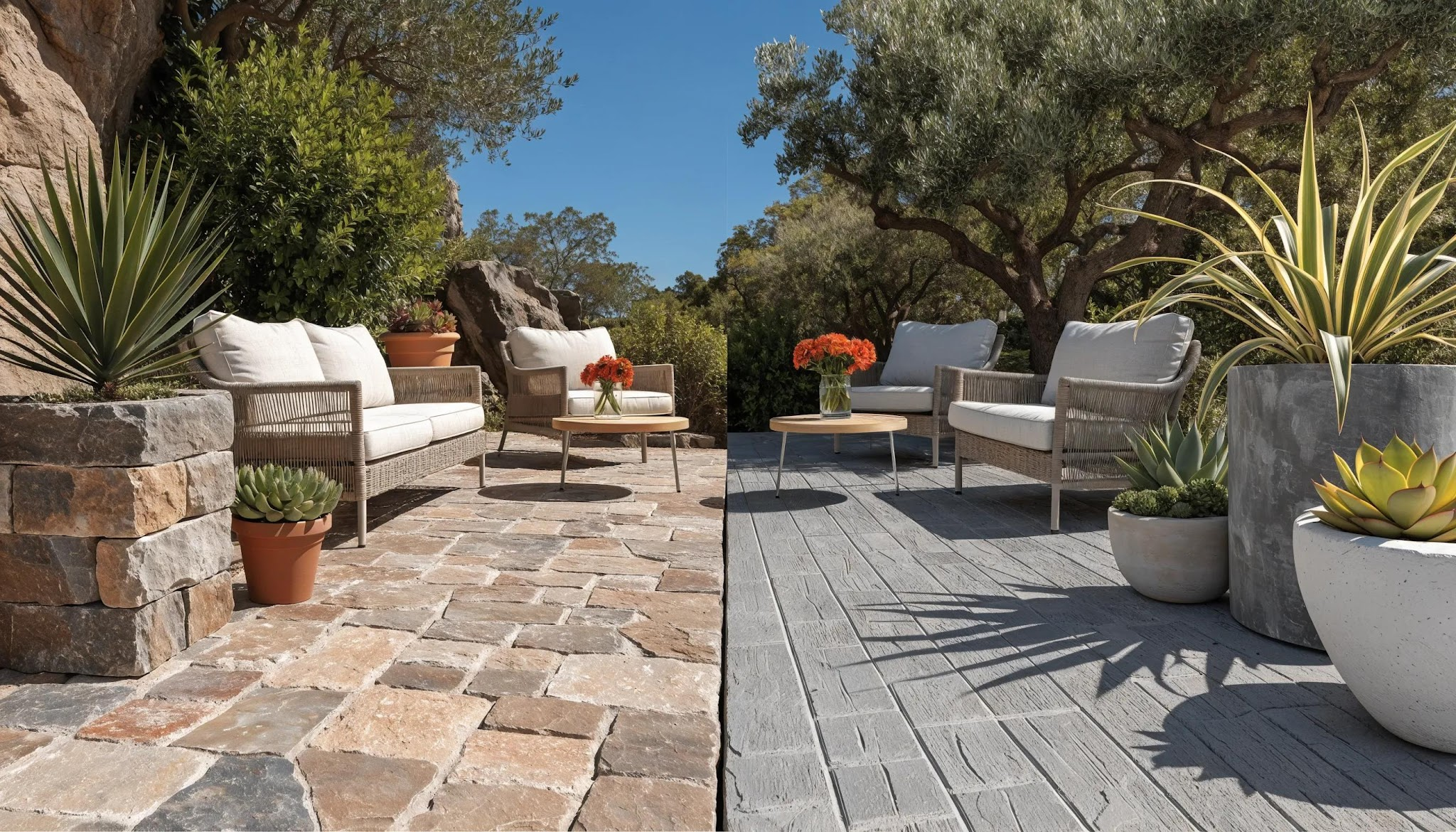 Similar visual goals can come from very different construction systems.
02 / Heat + Comfort
Surface comfort becomes more important in a warm Zone 9b climate.
The source generally describes custom pavers as offering better thermal regulation than stamped concrete, while also emphasizing that material type, color, and texture influence how much solar heat an outdoor surface absorbs.
Lighter surfaces generally reflect more sunlight than darker surfaces.
Natural-stone and other paver materials can respond to heat differently than a concrete slab.
Consider barefoot comfort around patios, pools, recreation areas, and other frequently used surfaces.
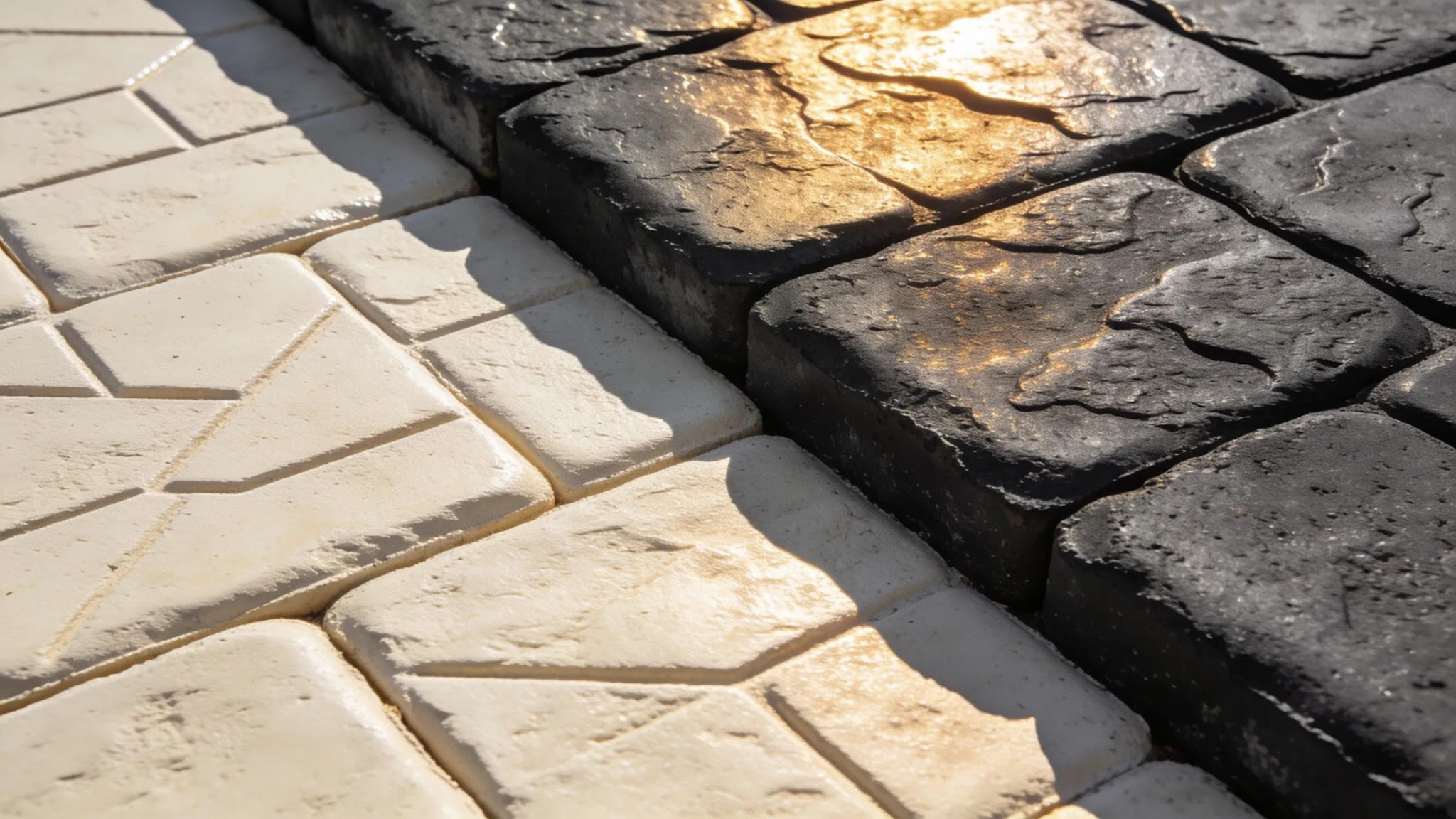 In hot weather, surface temperature becomes part of usability.
03 / Cost + Long-Term Value
Lower initial cost does not automatically mean lower lifetime cost.
The source presents stamped concrete as typically carrying a lower upfront installation cost, while custom pavers require more skilled placement and can cost more initially. Long-term planning should also consider cracking, individual-unit replacement, resealing, repairs, and potential service life.
Compare installed scope rather than material price alone.
Include future repair and maintenance expectations.
Treat published cost ranges as planning references, not project quotes.
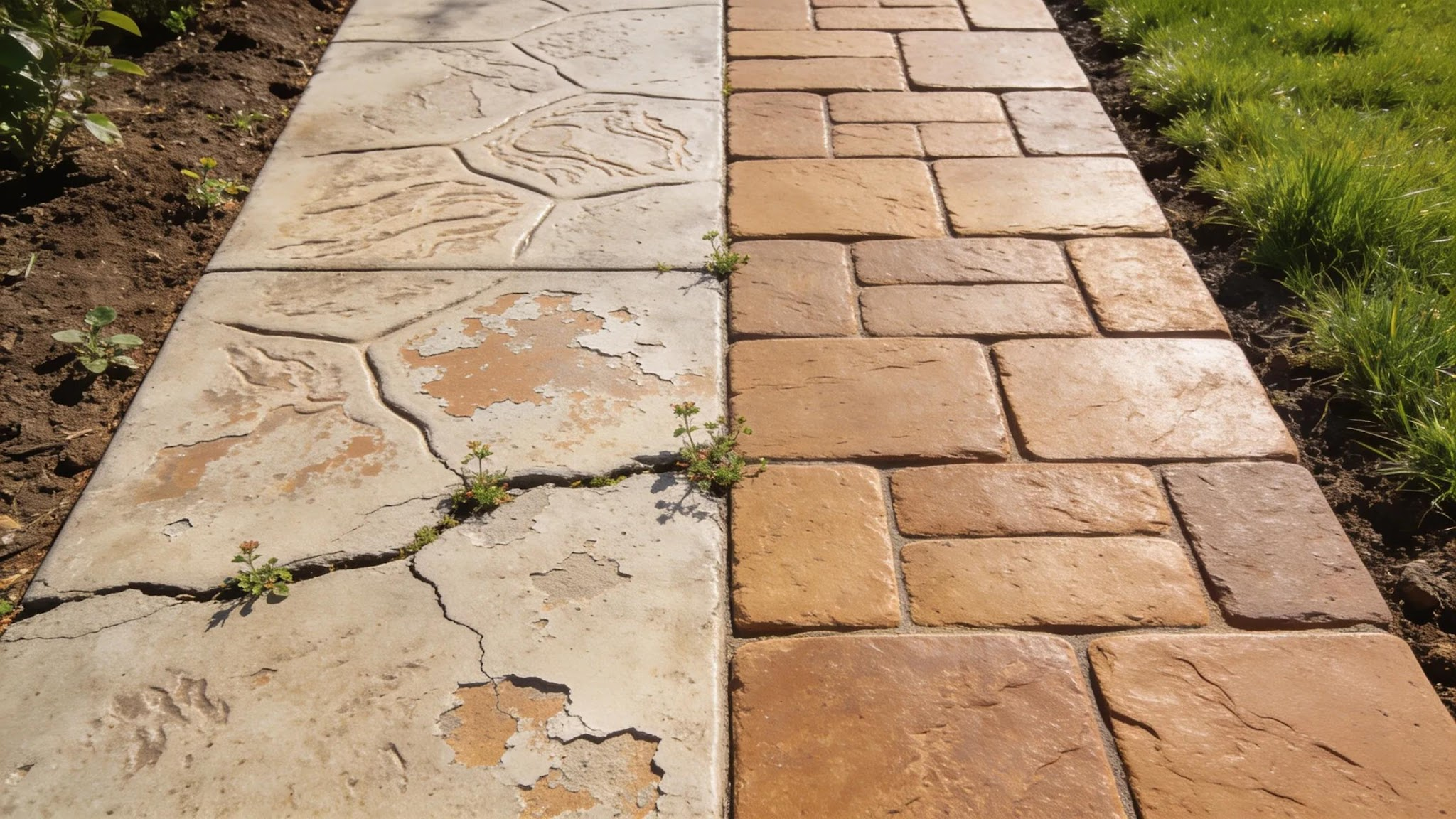 Upfront price is only one part of the ownership equation.
04 / Durability + Repair
Modular pavers and a continuous slab respond differently to movement.
The source presents custom pavers as better able to accommodate soil movement and temperature variation because individual units can move independently. If a paver is damaged, a localized unit can also be replaced. Stamped concrete can develop cracks or surface damage that may require broader repair.
Individual pavers allow localized replacement.
Interlocking systems can accommodate some movement between units.
Concrete cracking and surface deterioration should be considered in long-term planning.
Repair strategy matters almost as much as the original installation.
05 / Climate + Drainage
Heat, moisture, drainage, and soil movement all influence hardscape performance.
The guide describes Zone 9b as having long, hot summers and mild winters. It emphasizes temperature exposure, moisture, soil movement, and drainage when choosing between modular pavers and a continuous stamped-concrete surface.
Paver joints can support drainage when the overall system is designed appropriately.
Individual units can respond differently to soil movement than a continuous slab.
Proper base preparation remains essential for either system.
Climate adaptation starts underneath the finished surface.
06 / Aesthetics + Installation
Pattern flexibility and installation speed create a different trade-off for each system.
Custom pavers support a wide variety of colors, textures, materials, and patterns, while stamped concrete can imitate decorative surfaces with fewer individual pieces to install. The source says paver installation generally takes longer, while stamped concrete may be completed more quickly depending on design complexity.
Pavers provide broad design and material flexibility.
Stamped concrete can create decorative patterns with a poured surface.
Installation time depends on site preparation, project size, pattern complexity, and finishing requirements.
The best material is the one whose trade-offs match the project.
01
/ 06
Compare
Interactive Material Comparison
Compare the surface from more than one angle.
Explore construction, heat performance, installation cost, long-term ownership, cracking, repairability, drainage, Zone 9b climate response, design flexibility, and installation.
Similar visual goals can come from very different construction systems.
01 / Material Overview
One uses individual units. The other begins as a single slab.
Custom pavers may use natural stone, concrete, or clay units. Stamped concrete is poured as a slab and textured to imitate stone, brick, pavers, or other decorative materials.
Pavers provide modular construction and pattern flexibility.
Stamped concrete creates decorative texture in a continuous poured surface.
Heat, cost, durability, maintenance, and site conditions should guide the decision.
In hot weather, surface temperature becomes part of usability.
02 / Heat + Comfort
Warm-weather comfort depends on the material, finish, color, and exposure.
The source generally presents custom pavers as offering stronger thermal regulation than stamped concrete, while emphasizing that actual surface temperature varies by material, color, texture, and sunlight.
Lighter surfaces generally reflect more sunlight than darker surfaces.
Material composition affects how quickly surfaces absorb and release heat.
Consider barefoot comfort around patios, pools, walkways, and recreation areas.
Upfront price is only one part of the ownership equation.
03 / Cost + Long-Term Value
Lower initial cost does not automatically mean lower lifetime cost.
The source presents stamped concrete as typically less expensive to install initially, while pavers can require greater material and placement investment. Long-term planning should also include repair, resealing, maintenance, and service life.
Compare installed scope rather than raw material price alone.
Include repair and maintenance expectations in the budget.
Treat published price ranges as planning references rather than project quotes.
Repair strategy matters almost as much as the original installation.
04 / Durability + Repair
Modular pavers and continuous concrete respond differently to movement.
Individual paver units can move independently and damaged pieces can often be replaced locally. Stamped concrete can develop cracks or surface damage that may require a broader repair approach.
Individual pavers allow localized replacement.
Interlocking systems can accommodate some movement between units.
Decorative concrete repairs may require matching color and texture.
Climate adaptation starts underneath the finished surface.
05 / Climate + Drainage
Heat, moisture, drainage, and soil movement influence performance.
Zone 9b conditions include long, hot summers and mild winters. Drainage, moisture movement, soil conditions, and proper base construction should be considered for either flooring system.
Paver joints can support drainage when the full system is designed appropriately.
Individual units respond differently to soil movement than a solid slab.
Proper base preparation remains essential for both systems.
The best material is the one whose trade-offs match the project.
06 / Aesthetics + Installation
Pattern flexibility and installation speed create different trade-offs.
Pavers support broad variation in colors, textures, materials, and patterns. Stamped concrete can imitate decorative surfaces through a poured installation that may require less individual-unit placement.
Pavers provide broad design and material flexibility.
Stamped concrete can reproduce decorative patterns using one poured surface.
Installation duration varies with project size, preparation, design complexity, and finishing.
01
/ 06
Compare
Detailed Outdoor Flooring Guide
Compare both surfaces across six decision points.
Move beyond appearance and compare material construction, Zone 9b heat response, cost structure, maintenance, repairability, drainage, weathering, design flexibility, and installation.
Outdoor Flooring Decision Map
The stronger choice depends on how each surface fits the property's climate, budget, design goals, maintenance expectations, and long-term use.
Comparing:
Material Basics
01 / Material Basics
Understand how each flooring system is built before comparing performance.
Custom Pavers
Individual units create flexibility in material, pattern, movement, and repair.
Custom pavers may be manufactured from concrete or clay or use natural-stone units. Their modular construction allows homeowners to combine colors, textures, patterns, and shapes while keeping each piece individually serviceable.
Natural stone, concrete, and clay options.
Wide range of colors, textures, and laying patterns.
Damaged individual units can often be replaced locally.
Modularity changes both the design possibilities and the repair strategy.
Stamped Concrete
A poured concrete surface can reproduce decorative patterns without individual units.
Stamped concrete begins as poured concrete and is textured or patterned before curing to simulate stone, brick, pavers, or other decorative surfaces. The source presents this as a lower-initial-cost alternative in many projects.
Continuous poured concrete surface.
Decorative patterns and textures applied during installation.
Can visually imitate more expensive modular materials.
Stamping changes the appearance of the slab, not its underlying structural format.
Comparison Framework
The best choice depends on what matters most after installation.
The source consistently frames the comparison around four homeowner priorities: aesthetics, durability, cost, and heat resistance. Zone 9b climate and long-term maintenance add important context to those four variables.
Custom Pavers
Modular
Greater pattern flexibility and localized repair.
Stamped Concrete
Continuous
Decorative poured surface with typically lower initial installation cost.
Compare the system underneath the appearance.
02 / Heat + Zone 9b
Warm-weather comfort depends on material, color, exposure, and surface behavior.
Thermal Performance
The source generally favors pavers for thermal regulation in Zone 9b.
The guide describes custom pavers, particularly certain natural-stone and lighter-colored options, as tending to retain less uncomfortable surface heat than stamped concrete under intense sun. Actual temperature still depends on the specific material, color, texture, and exposure.
Material composition influences heat absorption.
Lighter surfaces generally reflect more solar energy.
Surface comfort matters most where people walk barefoot or gather outdoors.
Surface temperature influences whether an outdoor space is comfortable at peak heat.
Color + Texture
Finish selections can change the thermal experience of the same flooring category.
The source notes that darker surfaces absorb more heat while lighter materials reflect more sunlight. Texture and material composition can also affect how the surface feels and performs in direct sun.
Compare actual samples in sunlight when possible.
Consider shade patterns across the site.
Evaluate comfort around seating, pool decks, paths, and recreation zones.
Color is an aesthetic decision with practical heat consequences.
Drainage + Soil Movement
Zone 9b performance is not only about what happens on the surface.
The source emphasizes moisture movement, drainage, and changing soil conditions. Individual paver units can respond to movement differently than a solid slab, while joints may contribute to water movement when the entire base and drainage system are designed appropriately.
Base preparation is critical for either system.
Drainage should be designed for the actual property.
Soil movement can influence cracking, settlement, and long-term alignment.
Good hardscape performance begins below the visible finish.
03 / Cost + Ownership
Separate initial installation cost from long-term ownership cost.
Upfront Installation
The source presents stamped concrete as the lower-cost entry point.
Pavers generally require more individual placement and skilled labor, while stamped concrete can cover a large surface through a poured installation. Actual bids depend on site preparation, materials, access, design complexity, project size, and contractor scope.
Compare installed systems, not raw material cost alone.
Include excavation, base preparation, edging, drainage, and finishing.
Complex patterns or premium pavers can increase labor and material costs.
A surface price means little without understanding what the installation includes.
Source Planning Range
The supplied article includes per-square-foot planning figures for comparison.
Custom Pavers
$15–$30 / sq. ft.
Source editorial range.
Stamped Concrete
$8–$15 / sq. ft.
Source editorial range.
Pricing Disclaimer
Editorial figures — not a Lavish Gardens quote.
These ranges come directly from the supplied article and should be treated only as general planning references. Actual Rocklin pricing can vary with project size, material selection, site conditions, demolition, grading, base preparation, drainage, access, labor, design complexity, market conditions, and construction scope.
Source pricing is useful for orientation, not for replacing a site-specific estimate.
Maintenance + Ownership
Repair type can change the long-term economics of the surface.
The detailed maintenance sections of the source describe custom pavers as requiring relatively limited routine upkeep, while stamped concrete may require resealing and crack or surface repair over time. Neither system is maintenance-free.
Paver repairs can often be localized to affected units.
Stamped concrete may require periodic sealing depending on the finish and exposure.
Long-term cost should include maintenance and repair strategy, not only installation.
Maintenance costs become clearer when you know how each surface is repaired.
04 / Durability + Repair
Longevity depends on how the system handles traffic, movement, heat, moisture, and damage.
Movement + Cracking
Individual units and continuous slabs respond differently when the ground moves.
The guide presents pavers as more adaptable to soil movement and temperature fluctuations, while stamped concrete can develop visible cracking when the underlying slab is stressed.
Proper base construction is essential for either surface.
Pavers can distribute movement across joints.
A continuous slab can show cracking when movement exceeds what the system accommodates.
Durability is partly a question of how the system responds when conditions change.
Repairability
Localized replacement is one of the practical advantages of modular pavers.
If a paver becomes damaged, individual pieces can often be removed and replaced without rebuilding the entire surface. Repairs to decorative concrete may be more visible because the original color, texture, or stamped pattern must be matched.
Individual damaged pavers can often be replaced.
Utility access may also be easier to restore with modular units.
Decorative concrete repairs can involve matching an existing finish.
A repairable surface can simplify future corrections and access.
Source Lifespan Figures
The source assigns a longer potential lifespan to custom pavers.
Custom Pavers
25–50 years
Source expected-lifespan range.
Stamped Concrete
10–30 years
Source expected-lifespan range.
Longevity Note
Lifespan is highly installation- and site-dependent.
These are editorial ranges supplied by the article, not guarantees. Actual service life depends on base preparation, drainage, material quality, traffic, weather exposure, movement, maintenance, sealing, installation quality, and site conditions.
Lifespan begins with installation quality and the conditions underneath the surface.
05 / Design + Environment
The surface should fit both the architecture and the site.
Paver Design Flexibility
Modular materials provide broad control over pattern, texture, color, and scale.
Pavers can be selected in different materials, shapes, colors, and textures, making them useful when the surface needs to coordinate closely with the architecture, planting, walls, or other outdoor-living features.
Multiple laying patterns.
Natural stone, concrete, and clay aesthetics.
Ability to combine borders, fields, accents, and transitions.
Pavers can behave like a material palette rather than a single finish.
Stamped Concrete Aesthetics
Decorative stamping can reproduce the visual language of stone or modular paving.
Stamped concrete can be patterned and textured to simulate materials such as stone, brick, or pavers. Its continuous surface can create a cohesive visual field while keeping the construction method fundamentally concrete-based.
Wide variety of stamp patterns.
Decorative color and texture options.
Useful where a continuous decorative slab suits the project.
Decorative concrete can imitate modular materials while remaining a slab.
Environmental + Site Fit
Material selection should support drainage, landscape integration, and local conditions.
The source encourages homeowners to consider both environmental and aesthetic factors. Pavers can integrate naturally into landscape compositions, while site planning should also account for runoff, drainage, thermal exposure, and long-term hardscape performance.
Coordinate flooring with surrounding landscape materials.
Consider drainage and runoff during system design.
Choose materials that perform appropriately in the site's heat and moisture conditions.
Outdoor flooring succeeds when it belongs to both the home and the landscape.
06 / Installation + Decision
Installation speed matters — but the finished system matters longer.
Paver Installation
Individual-unit installation usually requires more layout and placement work.
The source says custom paver installations generally take longer because the base, layout, cuts, patterns, edging, and individual units require coordinated placement. It gives a broad editorial timeline of several days to about a week.
Timeline Note
Several days to about one week
This is the source article's general planning statement, not a project guarantee. Actual schedules depend on square footage, demolition, access, grading, drainage, base preparation, pattern complexity, weather, crew size, and project scope.
More individual pieces generally mean more layout and placement work.
Stamped Concrete Installation
Poured concrete can move through the surface-installation stage more quickly.
The source characterizes stamped concrete installation as typically faster than custom pavers and gives a general editorial statement of a couple of days depending on design complexity. Preparation, concrete placement, stamping, finishing, curing, and site conditions still affect the actual schedule.
Timeline Note
Approximately a couple of days in the source
This source figure is not a construction commitment. Full project duration can be longer once demolition, preparation, curing requirements, access, weather, and related landscape work are included.
Faster surface installation does not eliminate preparation, curing, or site requirements.
Final Decision
Choose the trade-offs that fit how the outdoor space will actually be used.
The guide recommends weighing aesthetics, durability, cost, and heat resistance together rather than selecting on one factor alone. For Zone 9b homeowners, climate response, drainage, soil movement, repairability, and long-term maintenance should also be part of the decision.
How hot will the surface become in its actual exposure?
What installation and long-term budget fits the project?
How important are localized repairs and movement tolerance?
Which colors, patterns, and textures best fit the property?
How will the system manage drainage and site conditions?
The right surface is the one whose strengths match the priorities of the property.
01
/
Material Comparison
Detailed Outdoor Flooring Guide
Compare both surfaces across six decision points.
Choose a topic, then swipe through deeper guidance on construction, Zone 9b heat response, installation cost, long-term ownership, repairability, drainage, design flexibility, and installation.
01 / Material Basics
Understand how each system is built before comparing performance.
Modularity changes both design flexibility and future repair strategy.
Custom Pavers
Individual units create flexibility in material, pattern, movement, and repair.
Custom pavers can use concrete, clay, or natural stone. Their modular construction supports varied colors, textures, patterns, and localized replacement.
Natural stone, concrete, and clay options.
Wide pattern and texture flexibility.
Individual damaged units can often be replaced.
Stamping changes the appearance of concrete without changing its slab construction.
Stamped Concrete
A poured slab can reproduce decorative patterns without individual units.
Stamped concrete is poured and then textured or patterned to simulate stone, brick, pavers, or other decorative surfaces.
Continuous poured concrete surface.
Decorative patterns applied during installation.
Can visually imitate more expensive materials.
Compare the system underneath the appearance.
Comparison Framework
The strongest choice depends on what matters after installation.
The article centers the decision on aesthetics, durability, cost, heat resistance, Zone 9b climate response, maintenance, and long-term performance.
Pavers
Modular
Flexible patterns and localized repair.
Stamped Concrete
Continuous
Decorative poured surface with lower initial cost in the source.
01 / 03
Swipe
02 / Heat + Zone 9b
Warm-weather comfort depends on material, color, exposure, and surface behavior.
Surface temperature affects how comfortable the outdoor space feels at peak heat.
Thermal Performance
The source generally favors pavers for thermal regulation in Zone 9b.
Certain paver materials and lighter surfaces can remain more comfortable than darker or heat-absorbing finishes, although actual temperature varies by product and exposure.
Material composition influences heat absorption.
Lighter surfaces generally reflect more solar energy.
Consider barefoot areas and frequently used gathering zones.
Color is an aesthetic decision with practical heat consequences.
Color + Texture
Finish selections can change the thermal experience within the same material category.
Darker surfaces generally absorb more solar heat, while lighter materials reflect more sunlight. Texture and material composition also influence the finished surface.
Compare actual samples in direct sunlight when possible.
Consider where shade falls during the hottest hours.
Evaluate seating, pool, path, and recreation zones separately.
Good hardscape performance begins beneath the finished surface.
Drainage + Soil Movement
Zone 9b performance is not only about what happens on top.
Drainage, moisture movement, soil conditions, and base construction affect both pavers and stamped concrete. Modular units respond differently to movement than a continuous slab.
Base preparation is critical for either system.
Drainage should be designed for the actual property.
Soil movement can affect settlement, alignment, and cracking.
01 / 03
Swipe
03 / Cost + Ownership
Separate initial installation cost from long-term ownership cost.
A square-foot price means little without knowing what the installation includes.
Upfront Installation
The source presents stamped concrete as the lower-cost entry point.
Pavers generally require greater individual placement and can involve higher material and labor costs. Stamped concrete may cover a large area more quickly through a poured installation.
Compare installed systems rather than raw material prices.
Include excavation, grading, base work, edging, and drainage.
Premium materials and complex patterns increase scope.
Source pricing is useful for orientation, not for replacing a site-specific estimate.
Source Planning Range
The supplied article includes general per-square-foot planning figures.
Custom Pavers
$15–$30 / sq. ft.
Editorial source range.
Stamped Concrete
$8–$15 / sq. ft.
Editorial source range.
Pricing Disclaimer
Not Lavish Gardens pricing.
These figures come from the supplied article and are general planning references only. Actual pricing depends on materials, square footage, demolition, access, grading, drainage, base preparation, labor, design complexity, market conditions, and construction scope.
Maintenance becomes clearer when you understand how the surface is repaired.
Maintenance + Ownership
Repair type can change the long-term economics of the surface.
The detailed source sections describe pavers as relatively straightforward to repair locally, while stamped concrete can require crack repair and periodic resealing depending on exposure and finish.
Paver repairs can often be localized.
Stamped concrete may require periodic sealing.
Neither flooring system is maintenance-free.
01 / 03
Swipe
04 / Durability + Repair
Longevity depends on traffic, movement, heat, moisture, and damage.
Durability is partly about how the surface responds when conditions change.
Movement + Cracking
Individual units and continuous slabs respond differently to movement.
The source presents pavers as more adaptable to temperature changes and soil movement, while stamped concrete can develop visible cracking if the slab is stressed.
Proper base construction is essential for either surface.
Pavers can distribute movement across joints.
Concrete can show cracking when movement exceeds system tolerance.
A repairable surface can simplify future corrections and utility access.
Repairability
Localized replacement is one practical advantage of modular pavers.
Individual damaged pavers can often be removed and replaced without reconstructing the entire surface. Decorative concrete repairs may require matching the original color, pattern, and texture.
Replace isolated damaged pavers.
Modular systems can simplify access beneath the surface.
Concrete repairs may remain visually noticeable.
Lifespan begins with installation quality and the conditions beneath the surface.
Source Lifespan Figures
The supplied article assigns a longer potential service life to custom pavers.
Custom Pavers
25–50 years
Source editorial range.
Stamped Concrete
10–30 years
Source editorial range.
Longevity Note
These are not guarantees.
Actual lifespan depends on material quality, base preparation, drainage, traffic, movement, UV and weather exposure, maintenance, sealing, installation quality, and site conditions.
01 / 03
Swipe
05 / Design + Environment
The surface should fit both the architecture and the site.
Pavers can behave like a material palette rather than a single finish.
Paver Design Flexibility
Modular materials offer broad control over pattern, texture, color, and scale.
Pavers can coordinate closely with architecture, retaining walls, outdoor kitchens, planting, and other outdoor-living elements.
Multiple laying patterns.
Natural stone, concrete, and clay aesthetics.
Borders, field patterns, accents, and transitions.
Decorative concrete can imitate modular materials while remaining a slab.
Stamped Concrete Aesthetics
Decorative stamping can reproduce the visual language of stone, brick, or pavers.
Stamped concrete supports various patterns, colors, and textures while maintaining a continuous poured-concrete construction system.
Wide variety of stamp patterns.
Decorative color and texture options.
Cohesive continuous visual surface.
Outdoor flooring works best when it belongs to both the home and landscape.
Environmental + Site Fit
Material selection should support drainage, climate, and landscape integration.
Flooring design should consider surrounding materials, runoff, drainage, thermal exposure, maintenance, and the way the hardscape connects visually to the property.
Coordinate with surrounding landscape materials.
Consider drainage and runoff.
Choose finishes appropriate for site heat and moisture.
01 / 03
Swipe
06 / Installation + Decision
Installation speed matters — but the finished system matters longer.
More individual pieces usually mean more layout and placement work.
Paver Installation
Individual-unit installation generally takes more layout and placement work.
Base construction, patterns, cuts, edging, individual-unit placement, and finishing can make paver installation more labor-intensive.
Source Timeline
Several days to about one week
This is a general editorial planning statement from the source, not a project guarantee. Actual timelines vary with demolition, grading, drainage, access, square footage, pattern complexity, weather, and crew size.
Faster surface installation still requires preparation, finishing, and curing.
Stamped Concrete Installation
Poured concrete can move through the surface-installation stage more quickly.
Stamped concrete eliminates individual-unit placement, but site preparation, concrete placement, stamping, finishing, curing, weather, and access still affect the full project schedule.
Source Timeline
Approximately a couple of days
This is the source article's broad planning statement, not a construction commitment. Total project time can be longer once demolition, preparation, curing, and related work are included.
The right surface is the one whose strengths match the priorities of the property.
Final Decision
Choose the trade-offs that fit how the outdoor space will actually be used.
Evaluate aesthetics, durability, cost, heat resistance, drainage, repairability, soil movement, long-term maintenance, and installation as one decision rather than choosing from appearance alone.
How hot will the surface become in actual exposure?
What installation and long-term budget fits the project?
How important are localized repairs and movement tolerance?
Which colors and textures fit the property?
How will the system manage drainage and site conditions?
01 / 03
Swipe
Begin
Discuss your landscape design & construction project with Michael & Susan Cole.

Michael & Susan Cole
FOUNDERS
Rocklin, CA · 35+ years
Begin
Discuss your landscape design & construction project with Michael & Susan Cole.
Michael & Susan Cole
FOUNDERS
Rocklin, CA · 35+ years
Premier landscape design-build studio. Owned & led by Michael & Susan Cole. Rocklin, CA · 35+ years.
Michael & Susan Cole
founders
Rocklin, CA · 35+ years
Hardscape
Outdoor & Sustain
Water & Light
Landscape Design · Service Area
© 2026 Lavish Gardens Landscape · Michael & Susan Cole
Rocklin, CA · CA Lic. #1110575 C-27 Landscape Contractor
Premier landscape design-build studio. Owned & led by Michael & Susan Cole. Rocklin, CA · 35+ years.
Michael & Susan Cole
FOUNDERS
Rocklin, CA · 35+ years
Hardscape
Outdoor & Sustain
Water & Light
Landscape Design · Service Area
© 2026 Lavish Gardens Landscape · Michael & Susan Cole
Rocklin, CA · CA Lic. #1110575 C-27 Landscape Contractor